
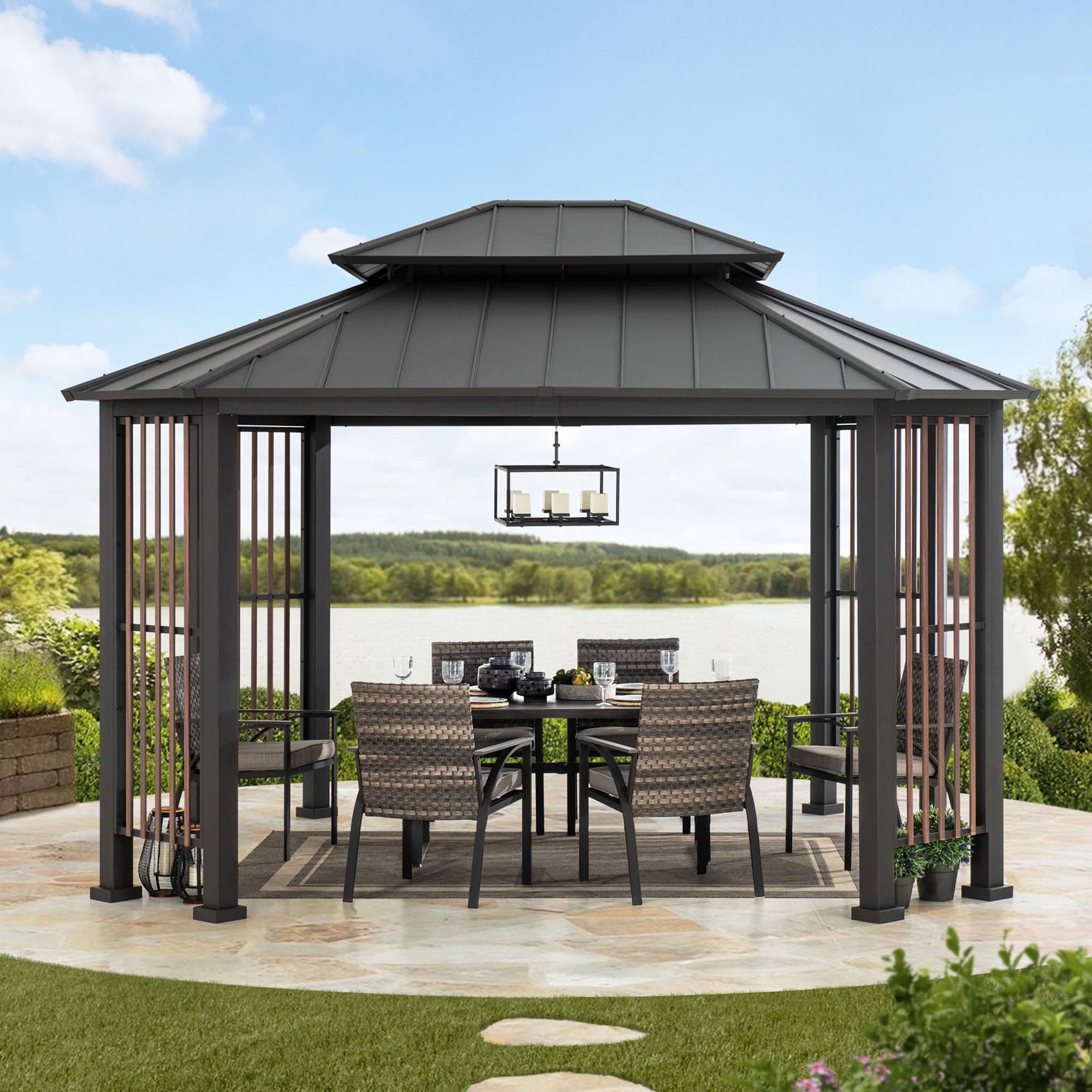
Before you settle on Sunjoy Outdoor Gazebos, think about matching dimensions to patio furniture for product page comparisons
Compact yards leave little room for guesswork. When comparing SUNJOY outdoor gazebos, start with the furniture and routines the space must support. A dining table, lounge chairs, grill area, or open walkway each creates a different footprint. The right product is not simply the one with the most attractive roof or finish. It is the one whose listed dimensions make sense beside the items you already own.

Start with the space, not the product list
Measure the usable patio or deck area first. Record its length and width, then note steps, doors, fences, planters, downspouts, and other fixed features. Include the path people need to reach the house or move around the furniture.
Next, measure the furniture as a group. A table needs more than its tabletop footprint because people must sit, stand, and pull out chairs. A lounge arrangement also needs space around its edges. If the gazebo will cover a grill or serving area, include the working space used while preparing food. These measurements give you a practical boundary for product-page comparisons.
Do not treat every open patch as usable floor area. A structure may fit inside the patio outline but still make the space difficult to use. Sketch the furniture arrangement with simple rectangles. Mark the main entrance and the direction of movement. This makes crowded corners easier to spot before you compare models.
Read dimensions and labels as separate evidence
Product pages often combine measurements with labels about roof type, material, shape, or intended setting. Keep those details in separate notes. Dimensions help you judge physical fit. Labels help you sort the options you want to investigate. Neither should replace the other.
The SUNJOY collection page lists hard-top, soft-top, and wood gazebo categories and displays product listings with sizes and material or roof labels. That gives a shopper a useful starting point when browsing gazebos for sale, but it does not establish one fixed range of models or sizes. The live collection can change, so compare the exact listing rather than relying on a general category name.
Use the product page to capture the stated overall size first. Then record the roof type, material, shape, column dimensions, and product type when those details are shown. Column dimensions matter in a compact space because posts can reduce the clear area available for chairs or walking. A listed overall size alone may not show how comfortably your furniture will sit inside.
Product examples on the collection page include cedar, PC-roof, aluminum, solar, poolside, and pergola products. Treat these as displayed product descriptors, not as promises about performance or suitability for every patio. A label can help narrow your search, while the specific listing determines which details apply to the model you are considering.
Separate fit from assumptions
A clean comparison avoids filling gaps with guesswork. If a page states an overall size, use that number as a screening point. Do not assume the usable interior is identical to the outside measurement. Posts, roof edges, furniture clearance, and access paths may change the practical fit.
Also avoid assuming that similar labels mean identical construction or included parts. A hard-top listing and a soft-top listing belong to different categories, but the category alone does not answer every question about a particular model. The same caution applies to material names, shape labels, and examples shown near the top of a collection page.
For a small patio, rank the constraints before comparing appearance. The first constraint may be the furniture footprint. The second may be the available walking route. The third may be the location of doors, windows, or drainage. Only after those checks should you weigh roof type, material, or visual style. This order reduces the risk of choosing a product that looks suitable but makes the patio harder to use.
Turn the product page into a short checklist
A comparison works best when every candidate is judged against the same notes. Save the listed overall size and the details that affect the footprint. Mark whether the model belongs to the roof or material category you want to explore. Then compare those entries with your furniture sketch.
Use the collection filters as a sorting aid. The page exposes filters for overall size, roof type, column dimensions, product shape, material, price, and product type. Filtering can reduce the number of listings you inspect, but it does not replace reading the selected product page. Exact features can vary by model.
Keep a short list rather than collecting every possible option. For each candidate, answer three practical questions: Does the listed size fit the measured area? Do the columns leave enough room for the furniture and walking route? Are the displayed roof, material, shape, and product-type labels consistent with the use you planned? If one answer is unclear, keep that uncertainty visible instead of treating it as a yes.
Make the final choice around actual use
The best comparison ends with a realistic scene. Picture the patio during the activity that matters most. Can people sit down, pass behind the chairs, open the nearby door, and reach the table or grill? If the gazebo covers a lounge area, does the arrangement still leave a comfortable route through the space? These questions connect the product listing to daily use without adding unsupported claims about the model.
For compact outdoor spaces, dimensions should lead the decision. Category and material labels can help organize the search, while model-specific measurements and stated details support the final comparison. Match the selected listing to your furniture plan, access needs, and available footprint. That measured approach makes a SUNJOY choice clearer without assuming that every gazebo suits every patio.
- Compare the listed overall size with the measured patio area and furniture footprint.
- Check the displayed roof type, material, shape, and product type for the selected listing.
- Review column dimensions as part of the available space for furniture and movement.